
On Metrification
and other good intentions.

I was just out of high school when Canada made the shift from imperial to metric.
At the time, the change seemed like a whim. I remember standing in the produce section of the grocery store looking at the weigh scale suspended above the onions and carrots, its dial weighing ounces and pounds, and thinking how quickly an object can become obsolete.
I wasn’t thinking about how, up until that point, I’d been measuring my world based on a whim.
An inch? The length of three barley corns.
A foot? The length of a human foot though I’m not sure whose.

As Wayne likes to say, “The imperial system is based on belief. The metric system is based on science.”
With the metric system, a metre is “the distance travelled by light in a vacuum in 1/299792458 of a second.”
A kilogram is arrived at by “setting the Planck constant h to 6.62607015×10⁻³⁴ J⋅s (J = kg⋅m2⋅s−2).”
While it might be easier to imagine units of measure using tangible objects than with wavelengths of light and abstract formulas, the metric system, in its immutability, seems a much more enlightened way to measure our world.
Which doesn’t mean there aren’t a number of us still struggling to make the switch (it hasn’t helped that many, if not most, measuring devices continue to include both systems, making it easier for people like me to default to what I know best).
One of the hurdles in my newfound interest in cooking?
Working my way through a recipe.
Some recipes give their ingredients in imperial measurements, others in metric. In at least one example, the amount of protein is given in grams, bouillon in cups, and spices in teaspoons.
My measuring cup is a chimera of composite parts, one side measuring millilitres and litres, another measuring cups, ounces, and pints, and a third providing a few “approximate conversions.” While the intentions may be good, too many options often lead me astray.
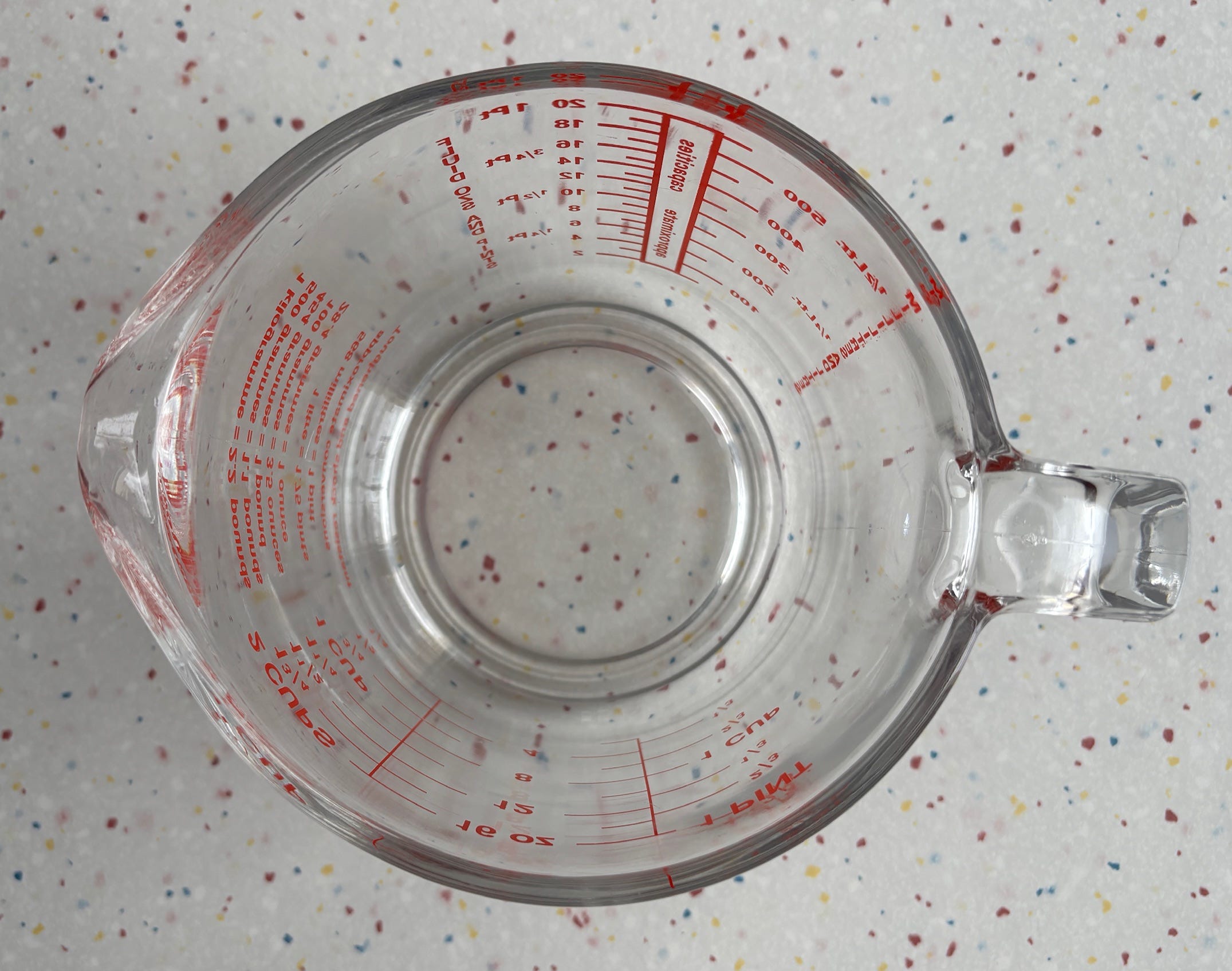
Eventually those of us educated in the imperial system will die out. When we do, these measuring cups will become artefacts of the past, obsolete museum pieces reminding us that some beliefs must be left behind if we are to further our understanding of the world. And that such transitions can take time.
Until then, I’m buying a kitchen conversion chart.